I was binging older Star Trek reruns (Sir Patrick Stewart, RIP), when The Best of Both Worlds came on. The one where the crew fights the Borg by changing phaser frequencies. The tactic works for a moment, the Borg adapt, and then the crew has to change again… and again. (episode here)

Seasonal changes to the identity infrastructure behind online advertising feel familiar. Each round brings frenzy and discussion about measurement, ad spend, and publisher revenue. Browsers tighten things, the industry pivots, and data teams pick up the pieces on what still works and what changed.
A few weeks earlier, on a cold grey Seattle evening in October, I read WebKit’s post on blocking identity resolution infrastructure and all the much warranted discussion online on who was blocked and who was spared.
The post said “First party personalization is not tracking, and is not what our technologies seek to prevent.” I wanted to see which IDs on a page are actually getting hit.
Checking a few publisher pages and the Console in Safari turned up “Blocked by tracking protections”, the error everyone online was posting about. I checked Yahoo News and saw api.rlcdn.com return 0 bytes with “Blocked by tracking protections” in the Console. On the same page, match.adsrvr.org came back 200. That was enough to make me want a bigger sample.
The joy of being alive in 2026 means agents can do the grunt work I would have balked at previously. Clicking endlessly through publisher websites in Chrome and Safari is easy when you have agents driving, running the probes, dumping the results and clearing the todo list like John Wick.
Prebid.js is the software websites use to let multiple ad companies bid to show an ad. The easiest thing to check was the user IDs that Prebid makes available to those companies. That revealed which IDs were present on each page. It’s a way to see if WebKit’s identity blocks hit the auction path, and it made it easier to brainstorm some automated tools (that’s another post) to monitor these changes.
I picked a few news and content sites and checked that each ran Prebid in the browser before including it.
Essential reads
The article by FASilytics covers which endpoints still work and how to audit your site. It’s a good primer on impact to measurement, publishers, and the uncertainty surrounding the blocklists.
UID2’s docs call out that on iOS 27 and macOS 27, WebKit blocks client-side requests to uidapi.com, so the JS SDK can’t load, generate or refresh tokens in affected browsers, including Safari on Mac.
Block Party
rlcdn.com, the domain behind the Yahoo request, is one of eight domains named in WebKit bug 324771.
To confirm the blocks were real and not page-specific, the agent served a small page that requests one hostname under each of the eight ticket domains. Safari 27.2 refused seven of them on every one of five reloads. match.adsrvr.org was sent every time. The same page in Chrome 158 sent all eight. All eight hosts answered curl from the same Mac, so the refusals were not due to the network connection.
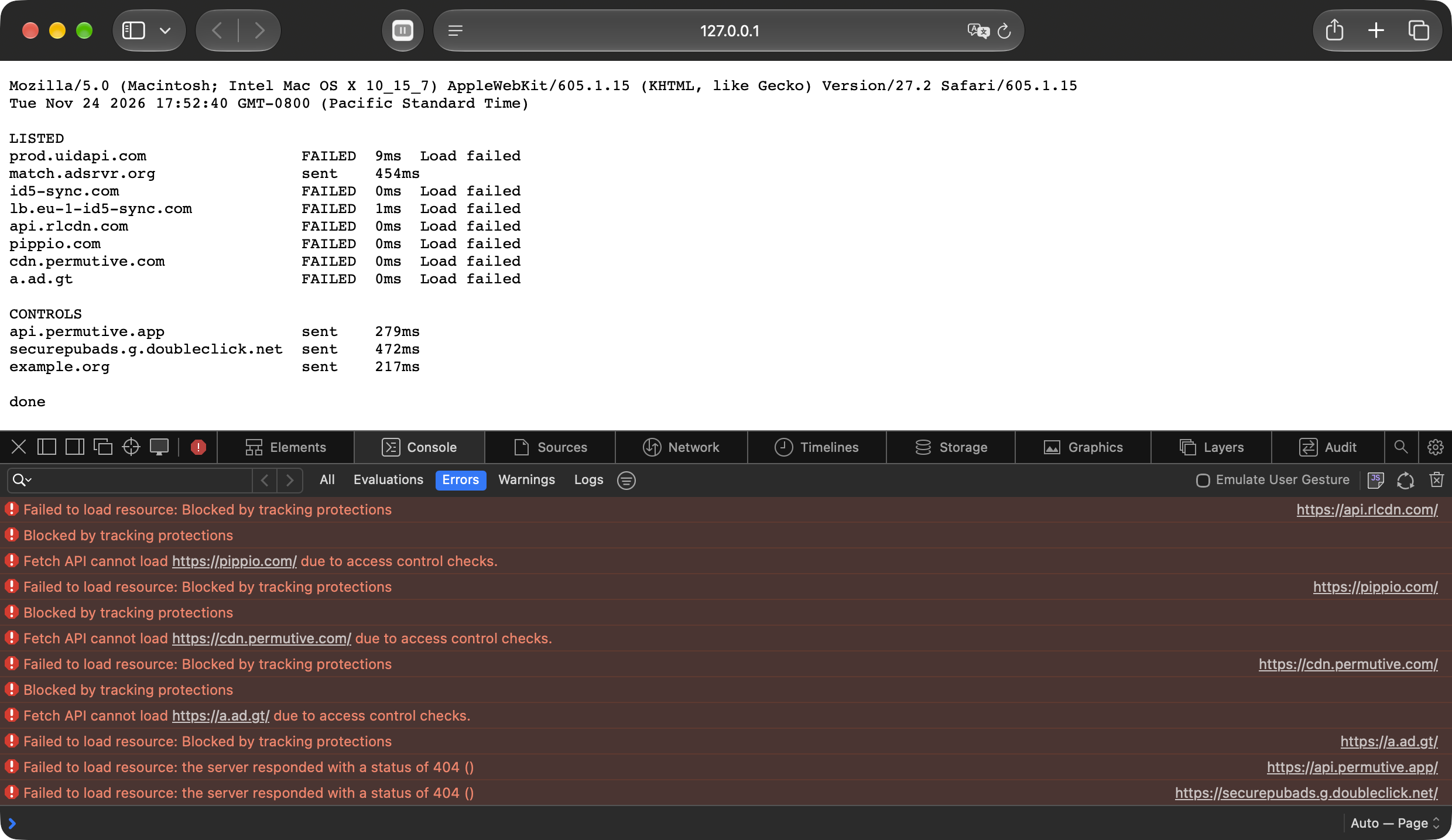
match.adsrvr.org goes out. The Console shows “Blocked by tracking protections” for api.rlcdn.com, pippio.com, cdn.permutive.com and a.ad.gt. The two controls that left the browser came back 404 from the server.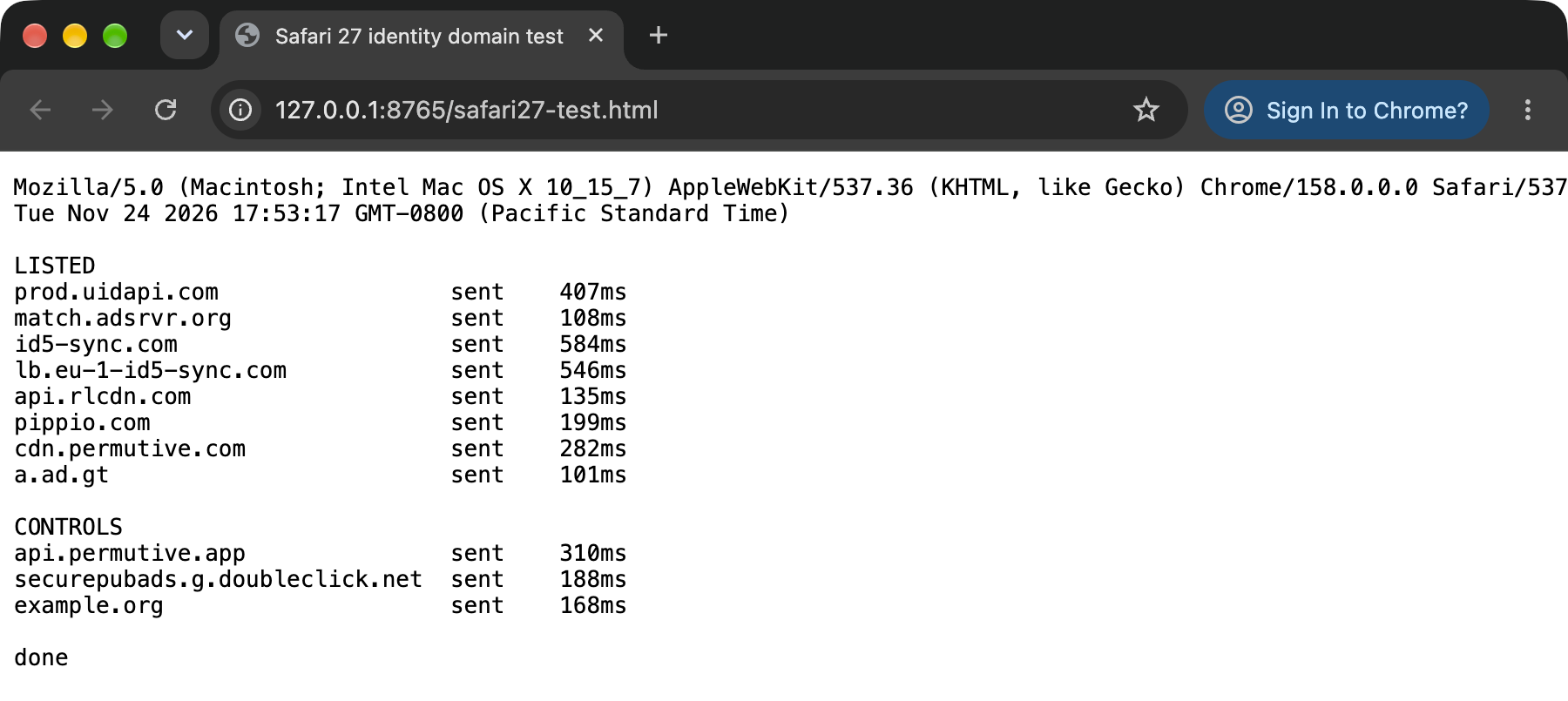
adsrvr.org was one of eight domains on the list at launch. WebKit later marked the ticket “Confirmed resolved” after pointing The Trade Desk to the iOS 27.2 beta 3. A diff of that beta shows adsrvr.org gone from the list. adserver.org is the label Prebid uses for The Trade Desk’s ID in the eid list. adsrvr.org is the network domain. On the release build here, Prebid’s adserver.org ID shows up in Safari on several pages below. That fits with something taken off the list working again. It matches the ticket being resolved, though the ID could be sitting in storage from before.
How Prebid exposes IDs
Prebid builds a list of user ids (eids). Each entry has a source (domain name) and the ID itself. The function pbjs.getUserIdsAsEids() returns this list, which bidder adapters can use when building requests to buy ad space.
For example, on the Yahoo News site in Chrome, the page held eids including liveramp.com, uidapi.com, adserver.org and pubcid.org. The Yahoo page reported an empty userSync.userIds config, so those eids were not coming from a visible Prebid ID module list. Something else on the page is writing them. Same URL in Safari with tracking protections on still had uidapi.com, pubcid.org and adserver.org. It did not have liveramp.com.
Separately, on BBC News, Safari’s Web Inspector showed blocked requests to cdn.id5-sync.com and check.analytics.rlcdn.com.
Checking for multiple pages
I prompted the agent to run on Chrome, then Safari-on, then Safari-off on the same 9 publisher pages that run Prebid in the browser.
Two loads per condition; the table uses the second load. That gives tags time to settle on the first load, so the second load isn’t still waiting on sync. When a consent button came up, the agent clicked it (CNN - Agree, NYPost - Got it).
Counting the IDs/Domains
The agent checked which user IDs Prebid reported on each page using getUserIdsAsEids(). This shows which IDs were available, not whether they were collected during that visit or sent to advertisers. Some could have been saved from an earlier visit. Also, an ID’s source label doesn’t tell you how it arrived. For example, ID5 or LiveIntent can supply a UID2-related ID, so seeing uidapi.com in Prebid’s list does not prove Safari contacted that domain.
I ran the Safari agent via AppleScript, and since it cannot read the Safari console directly, the table has no “Blocked by tracking protections” line per cell. I opened Web Inspector once during the table run, on the Safari-on BBC load, and saw blocks for cdn.id5-sync.com and check.analytics.rlcdn.com. For every other Safari missing cell there is no matching Console line, so I can’t say why they’re missing.
The agent ran every page in the table, automating the step-by-step process below.
Tools used
Safari 27.2 on macOS 27.2.1 and Chrome 157 (table run), both logged out with fresh profiles. The Safari side was driven via AppleScript, which is also why the Console lines could not be captured per cell.
The agent I used was on GLM-5.3.
The model didn’t need to be smart. It needed to run the same loop 54 times without drifting, and it did. Reading the Safari Console still needed my intervention with Web Inspector open.
The Prompt
This is the prompt behind the table, trimmed to what matters:
For each of these 9 pages: bbc.com/news, businessinsider.com, cnn.com, independent.co.uk, nypost.com, sfgate.com, sportskeeda.com, uproxx.com, yahoo.com/news
Run three conditions in this order: Chrome with default settings, Safari with default settings (Prevent cross-site tracking on), then Safari with Prevent cross-site tracking off.
For each condition and page:
- Start from a fresh browser profile or cleared website data, logged out.
- Load the page with the network log preserving across loads, and click any consent button that comes up.
- Wait 45 seconds for tags to settle, run the snippet below, and record the eid sources plus the pbjs version.
- Reload, wait 45 seconds again, run the snippet a second time. The second run is what goes in the table.
After the Safari-on pass on all pages: turn off Prevent cross-site tracking and Hide IP address from trackers, wipe Safari website data, repeat the loads, then restore both settings.
Return a table with site, condition, and which eid sources were present or missing.
Step by Step (if run manually)
- With a fresh browser profile, pick a page that runs Prebid.
- In Chrome: open DevTools > Network, select Preserve log, then load the page. Note the consent choice if there is one, wait 45 seconds, paste the snippet below in the Console, copy the output, then reload. Wait 45 seconds again and run the snippet a second time. The second run is what goes in the table.
- In Safari with default settings: Develop > Show Web Inspector, Network tab, Preserve Log checked. Same two loads, same snippet. Also copy any “Blocked by tracking protections” lines from the Console. You need those lines to tie a missing ID to the block.
- Settings > Privacy, untick Prevent cross-site tracking and Hide IP address from trackers, wipe Safari website data, repeat the two loads, then tick both settings back on.
- Compare the outputs. An ID present in Chrome and Safari-off but missing in Safari-on, with a block line naming that vendor’s domain on the same Safari-on load, is a block.
(() => { const out = []; for (const n of (window._pbjsGlobals || ['pbjs'])) { const p = window[n]; if (p?.getUserIdsAsEids) out.push({ name: n, version: p.version, eids: p.getUserIdsAsEids().map(e => e.source) }); } return out; })()Y = present in getUserIdsAsEids(). . = not present.
Column names map to these source domains: id5 = id5-sync.com, uid2 = uidapi.com, liveramp = liveramp.com, audigent = audigent.com, adserver = adserver.org, pubcid = pubcid.org.
| site | browser | id5 | uid2 | liveramp | audigent | adserver | pubcid |
|---|---|---|---|---|---|---|---|
| bbc.com/news | chrome | Y | . | . | . | . | Y |
| safari-on | . | . | . | . | . | Y | |
| safari-off | Y | . | . | . | . | Y | |
| businessinsider.com | chrome | . | . | Y | . | Y | Y |
| safari-on | . | . | . | . | Y | Y | |
| safari-off | . | . | . | . | Y | Y | |
| cnn.com | chrome | . | . | Y | . | Y | Y |
| safari-on | . | . | . | . | Y | Y | |
| safari-off | . | . | . | . | Y | Y | |
| independent.co.uk | chrome | . | . | Y | . | . | Y |
| safari-on | . | . | Y | . | . | Y | |
| safari-off | . | . | Y | . | . | Y | |
| nypost.com | chrome | Y | . | . | . | Y | Y |
| safari-on | . | . | . | . | Y | Y | |
| safari-off | Y | . | . | . | Y | Y | |
| sfgate.com | chrome | Y | Y | Y | . | Y | Y |
| safari-on | . | Y | . | . | Y | Y | |
| safari-off | Y | Y | . | . | Y | Y | |
| sportskeeda.com | chrome | . | . | Y | Y | Y | . |
| safari-on | . | . | Y | Y | Y | . | |
| safari-off | . | . | Y | Y | Y | . | |
| uproxx.com | chrome | Y | Y | . | . | Y | Y |
| safari-on | . | Y | . | . | Y | Y | |
| safari-off | Y | Y | . | . | Y | Y | |
| yahoo.com/news | chrome | . | Y | Y | . | Y | Y |
| safari-on | . | Y | . | . | Y | Y | |
| safari-off | . | Y | . | . | Y | Y |
Findings
id5-sync.com is the clearest pattern: present in Chrome, gone in Safari-on, back in Safari-off on bbc, nypost, sfgate and uproxx. BBC is also the only page in the table where I copied the Console line myself (cdn.id5-sync.com, blocked) on the Safari-on pass. I didn’t catch a Console line on the other three, so I can’t call them blocked.
On sfgate in Safari-on, uidapi.com was present while the configured modules included id5Id and liveIntentId and not uid2. A source arrived without the UID2 module.
My hunch was ID5 or LiveIntent could have supplied it, or it could already have been saved in the browser.
audigent.com on sportskeeda survived all three conditions. liveramp.com on independent.co.uk and sportskeeda also survived Safari-on in this session.
The Non-Blocked
In the Safari-on category, pubcid.org was present on most of these pages, and adserver.org on many of them. Unlisted third parties such as Criteo and LiveIntent also showed up on several Safari-on loads.
Setting Off
The agent also unselected Prevent cross-site tracking (and Hide IP address from trackers), wiped Safari website data, re-ran the same pages, then put both settings back on. That brought id5-sync.com back on bbc, nypost, sfgate and uproxx.
liveramp.com stayed missing on businessinsider, cnn, yahoo and sfgate even with the setting off and data wiped. independent.co.uk and sportskeeda already had it in Safari-on. Turning it off didn’t bring everything back.
Safari-off differs from Safari-on in more than one way, since the same setting also turns Safari’s third-party cookie blocking off. The setting is on by default.
Next episode
I’ll rerun this when the next Safari build ships and update the table. The tool that automates it is the next goal. Another round of Borg blocks and changing phaser frequencies.